Everyone who grew up in the '80s understands how it was that people found themselves enthralled by
Happy Days and Michael Jackson gloves. If left to our own devices, we would have subsisted entirely on hits from an ever-present canister of Easy Cheese, too — our taste buds, cultural and otherwise, had yet to develop. But those who, like myself, grew up Christian during that time may experience more complex feelings when we think of the cultural productions we fell prey to via church. In the '70s and '80s, as the number of evangelicals grew, so did the amount of media targeted to that audience, and the first law of Christian pop culture was that every secular action would have an equal and usually inferior Christian reaction. Hence Christian heavy metal, rap, romance novels, and comic books — and today's Christian hardcore, chick lit, ironic T-shirts, and vampire novels. Even if we're no longer religious, we may still experience a wave of shame when we think about how we willingly submitted to this propaganda. Or a stricken heart as we realize that we're having a hard time dismissing the object as kitsch: Jesus might really be in there! And however we may feel about Jesus now, we're pretty sure it's not his fault he got trapped in the zeitgeist.
I thought I'd try to move past the shame and offer up a multimedia sampling of what an average Christian kid consumed in the days before the Left Behind novels and the Fray. Those who weren't there can experience bemusement and relief that they never came in contact with this stuff, and those who were there might appreciate someone reassuring them that they didn't dream it all up. That was indeed Archie and Betty quoting scripture to you.
1. ARMAGEDDON IT
If you went to church in any serious way in the '70s or '80s, you were probably traumatized by the 1972 film A Thief in the Night, which tells the story of a young woman who, because she does not receive Christ as her savior in time enough to be raptured with all her Christian friends, spends the rest of the movie trying to escape punishment by the Antichrist's new world order. I see that people online have described this film, produced by one of the producers of The Blob, as prime fodder for Mystery Science Theatre 3000. I wish I had had the luxury of knowing this film only as something to be reclaimed for an evening of ironic commentary while eating pizza. Instead, it was presented to me as eventual fact, with commentary about the kinds of torture Christians had endured over the years so we would understand just what the Antichrist would do if we came to Jesus too late. But when I watched this again a few years ago, in the wake of Left Behind hysteria, I found myself feeling affection and admiration for it: filmed on location in Iowa, it scared the crap out of people without recourse to ominous Spielbergian scores and Kirk Cameron. Because the scale was human and the cinematography scruffy, it was very easy as a kid to imagine how all these terrible things would happen right now in the world we lived in, and not the jetpacked future. There's a particularly effective scene where a young girl, at home on a Saturday afternoon, walks through her house looking for her mother while the suspense mounts: is her mother just around the corner or has she been raptured? She hasn't, but because of that moment, I can assure you that anyone who saw this as a child reflexively thinks "Raptured!" when they can't find someone in Target.
This is one relic I can recommend purely for the kitsch factor — primarily because of the opening credits, which feature a fictional band called the Fishmarket Combo and a song called "I Wish We'd All Been Ready" (written by Larry Norman, the late father of Christian rock, who could count Frank Black as a fan). Christian or not, you will stare, delighted and aghast, at the greasy, grainy early '70s as embodied by some awkward-looking young people singing state-of-the-art rec-room pop. Roll tape!
2. UNFUNNY PAGES
 This is one artifact that non-religious kids might have come across. A friend tells me of going to buy Archie comics with her brother only to come home and find that they'd accidentally snapped up the *#&@$% Christian Archie comics. Yes, there were such things. In the early '70s, Al Hartley, an Archie cartoonist who had recently become born again, was approached by Spire Christian Comics to create an evangelizing version of the series. Hartley, who had been reprimanded for having Archie witness in some stories, thought this was divine intervention. He claimed to have no trouble convincing Archie's publisher, John Goldwater, to license the characters, and later said that he thought Spire's comic-book version of The Hiding Place — a Christian classic about a Dutch woman who hid Jews from the Nazis — helped convince Goldwater that Christians weren't all that bad. The result was titles like Archie's Something Else, in which the gang, along with a new hippie friend converted by Big Ethel, shows a TV crew looking for stories of juvenile delinquency that Jesus is just alright with them. My sister and I owned a few of these, and what I got out of them was probably not what Hartley intended. It was from one of these comics that I learned my first piece of rock trivia: Jesus loved me, that I knew, but I had no idea that the lyrics for the Byrds' "Turn! Turn! Turn!" came from the book of Ecclesiastes! My friend also remembers that what really disturbed her, in addition to the preaching, was that Betty and Veronica seemed way more pneumatic than they did back in the heathen Riverdale. See for yourself!
3. CHURNED BUTTER WISHES AND CALICO DREAMS
After I had blown through all of Laura Ingalls Wilder and Maud Hart Lovelace, and before I transitioned to L. M. Montgomery, I ate up Janette Oke's novels of love and spiritual fortitude on the Canadian prairie. Oke, who published her first book, Love Comes Softly, in 1979, is described as the first Christian romance novelist, and since I left the fold she has written 75 more, with Michael Landon's son making film versions of a few for the Hallmark Channel. Starring Katherine Heigl and January Jones.
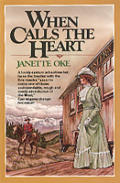 I bought her novels at our Christian bookstore because of the covers. On the front of When Calls the Heart, a young woman in dress from the early 20th century stood expectantly and with some trepidation on a train platform — what does her future hold?!? — while a Canadian mountie smoldered with virile conviction in the distance. Sold! At that point in my life you could have handed me anything depicting a girl with a pompadour and a shirtwaist on the cover and I would have read it. It didn't matter if the books were Christian or not. The quotation of scripture and references to her heroines' early morning prayers made comforting ambient noise as I read along for my real quarry: stories of leaving home and falling in love. The heroines might have been religious, but more importantly they were plucky. In When Calls the Heart, the heroine's teaching job set the story in motion, and the job came before the mountie showed up. I wouldn't recommend these, of course — apparently when I was 10 I didn't mind every line of dialogue knocking a G off of some unsuspecting present participle — but as I look through them now, I see that Oke allowed her heroines more agency than my churches allowed the women attending them. Which reminds me that the secular schoolteacher/governess/pioneer girl self-actualization genre has its own pieties: hard-working, compassionate girls who love their families and towns will always find husbands of commensurate ambition and kindness. Won't they?
4. JESUS WANTS ME FOR A SUNBEAM
In the '80s, Christian girls had two musical icons to choose from. Sandi Patty: blond, homecoming-queen hair, mother-of-the-bride dresses, operatic range, operatic gestures, all of it suggesting a spiritual range that you did not have it in you to reach. Or Amy Grant: long, brown, wavy hair defiantly unteased, crooked smiles, a blue-jeaned, brown-eyed voice that could occasionally turn gravelly. She was not overly feminine; she favored pants, and sometimes leather ones. For a preteen who knew she was not destined to become a sexpot, Grant's Relaxed Fit femininity and Relaxed Fit Christianity were comforting. "I may not be every mother's dream of her little girl," she sang in one of her early songs, and the peaceful, easy feelings communicated in her music softened the legalism around me. She was a pleasant reminder of all the Linda Ronstadt, Stevie Nicks, and Christine McVie I heard on the radio as a kid, and I like to think that in this way she paved the way to my love of Joni Mitchell. At least this is what I have to tell myself when I view concert footage like this. (The ladies may want to check out her kicky ensemble, a facsimile of which is probably hanging on the racks at Forever 21 as we speak.)
When I watch her sing the songs her then-husband wrote for her, and think about how she left him for country singer Vince Gill, and then remember that Sandi Patty divorced her husband, too, after an affair with a backup singer, I experience an unbecoming amount of schadenfreude. See, I think, sin comes for us all. But is it better to be Courtney Love, so that your sins would merely be will to power and feminist hypocrisy? I'm still working that out.